Minodu
Together with rural communities in the Kara region of northern Togo, students, researchers, and technical partners, the Minodu project co-designed a Local Community Network (LCN) that works without continuous internet access or electricity. It provides local weather data, agricultural audio content in French and Kabiyè, a community forum, and a market interface. The system combines low-cost hardware, environmental sensing, local knowledge, and community-based maintenance.
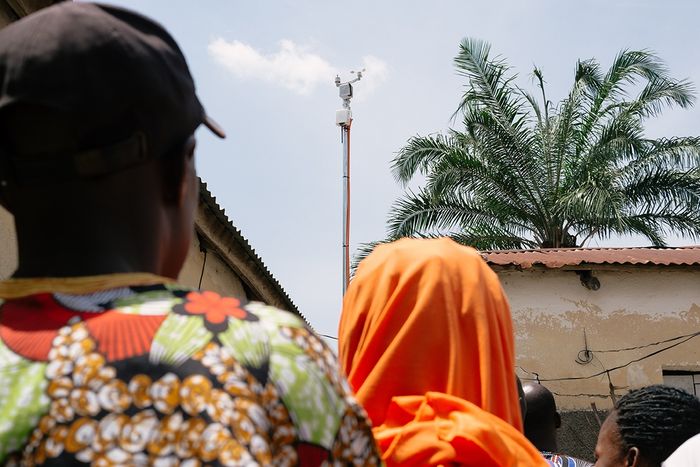
Minodu explores how decentralised, locally maintained digital infrastructures can support climate resilience in low-resource settings. Its aim is to bridge local knowledge with scientific knowledge to better address the effects of climate change. The project follows a co-design approach: we design, test, and build together. At the core of Minodu is the Local Community Network (LCN), a decentralised, offline-first system based on low-cost hardware and software. It combines environmental sensing, local data access, and community exchange. The system enables access to environmental data, agricultural advice, and community knowledge through local networks that operate without continuous Internet connectivity.
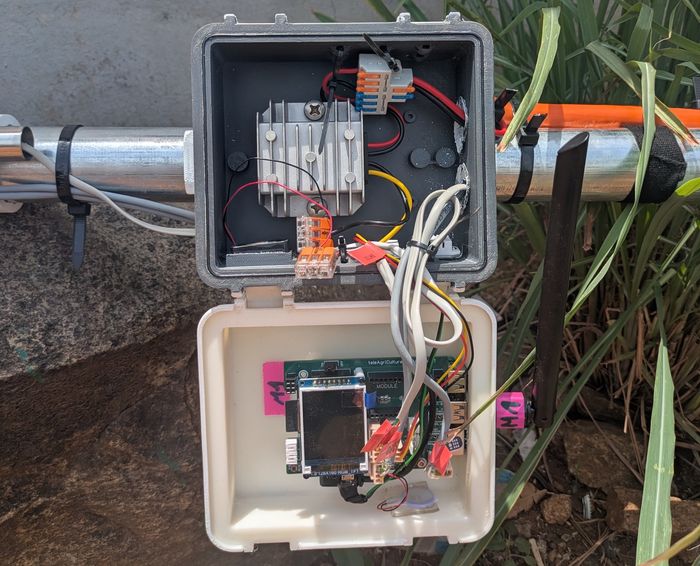
The Minodu Local Community Network (LCN) is a self-hosted, hardware weather station that runs entirely offline and offgrid and spans a local WI-FI network. It combines a Raspberry Pi with the Teleagriculture DIY sensor board to collect, process, and serve real-time environmental data.
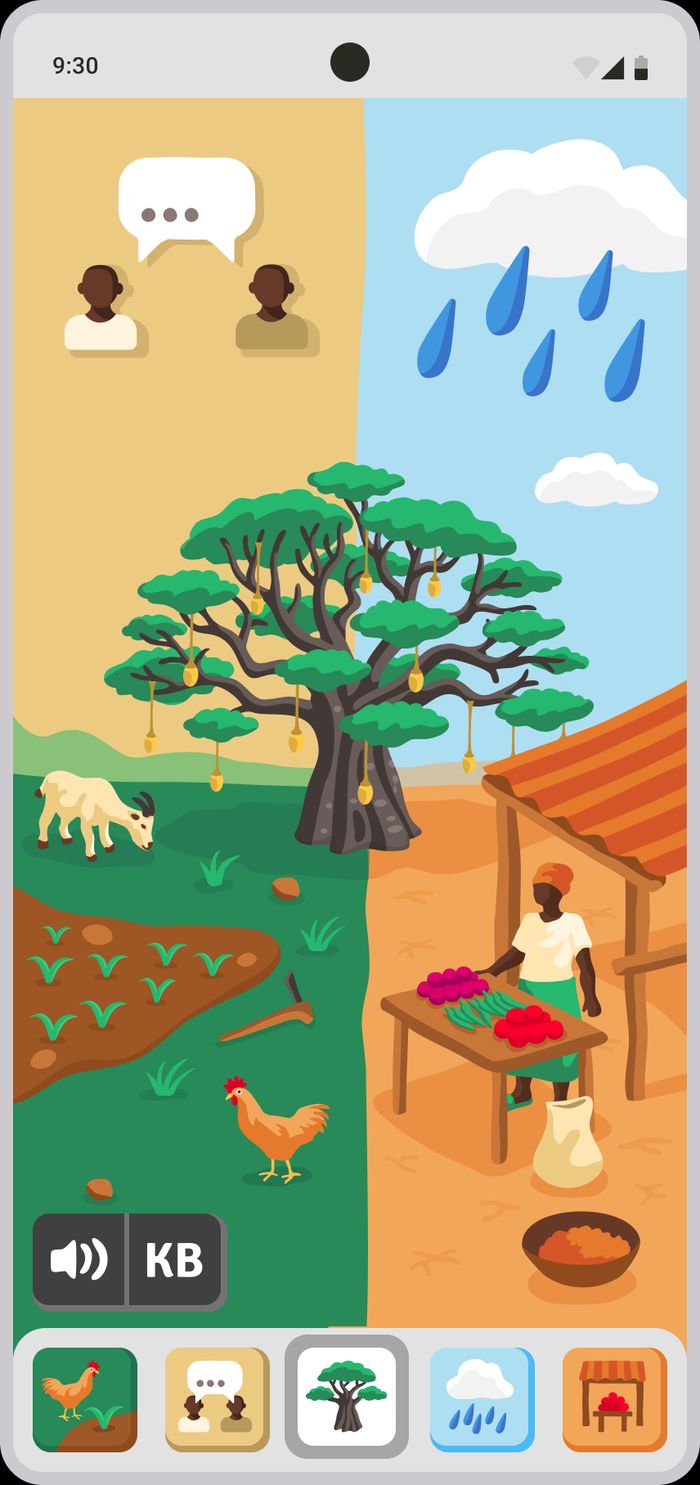
Users interact with the system using their smartphones to connect to the LCN over Wi-Fi, navigate the interface, and explore how local knowledge and data become accessible and applicable.
The application’s home screen is subdivided into four sections. Users can explore live weather data translated into visual metaphors, receive recommendations for agricultural practices in the local Kabiyè language and French, share text, photos or audio recordings in the forum, and see product requests on the marketplace. Auditory guidance for interactions is provided in Kabiyè and French.
The LCN’s hardware is designed for robustness and long-term deployment in low-infrastructure and high-temperature environments. Weather sensing components are housed in a 3D-printed Stevenson screen, mounted on a pole. The computing and networking unit is mounted in a protective case below. The system operates without internet access and is powered entirely off-grid using solar power. It provides access through acaptive portal to a browser-based GUI. By transforming data into symbols and audio transcriptions, the software reduces reliance on text and thereby improves accessibility.
The system also incorporates a locally hosted Large Language Model (LLM) that supports the interpretation of weather data and facilitates access to a knowledge database of agricultural practices.
Created in collaboration with Friederike Fröbel, Ousia FOLI-BEBE, Séti Afanou, Jannes Ulbrich, Carina Lange, Victoire Eyram Tsamedi and the German Research Center for Artifical Intelligence (DFKI). The project is funded by the BMBF.
← Back